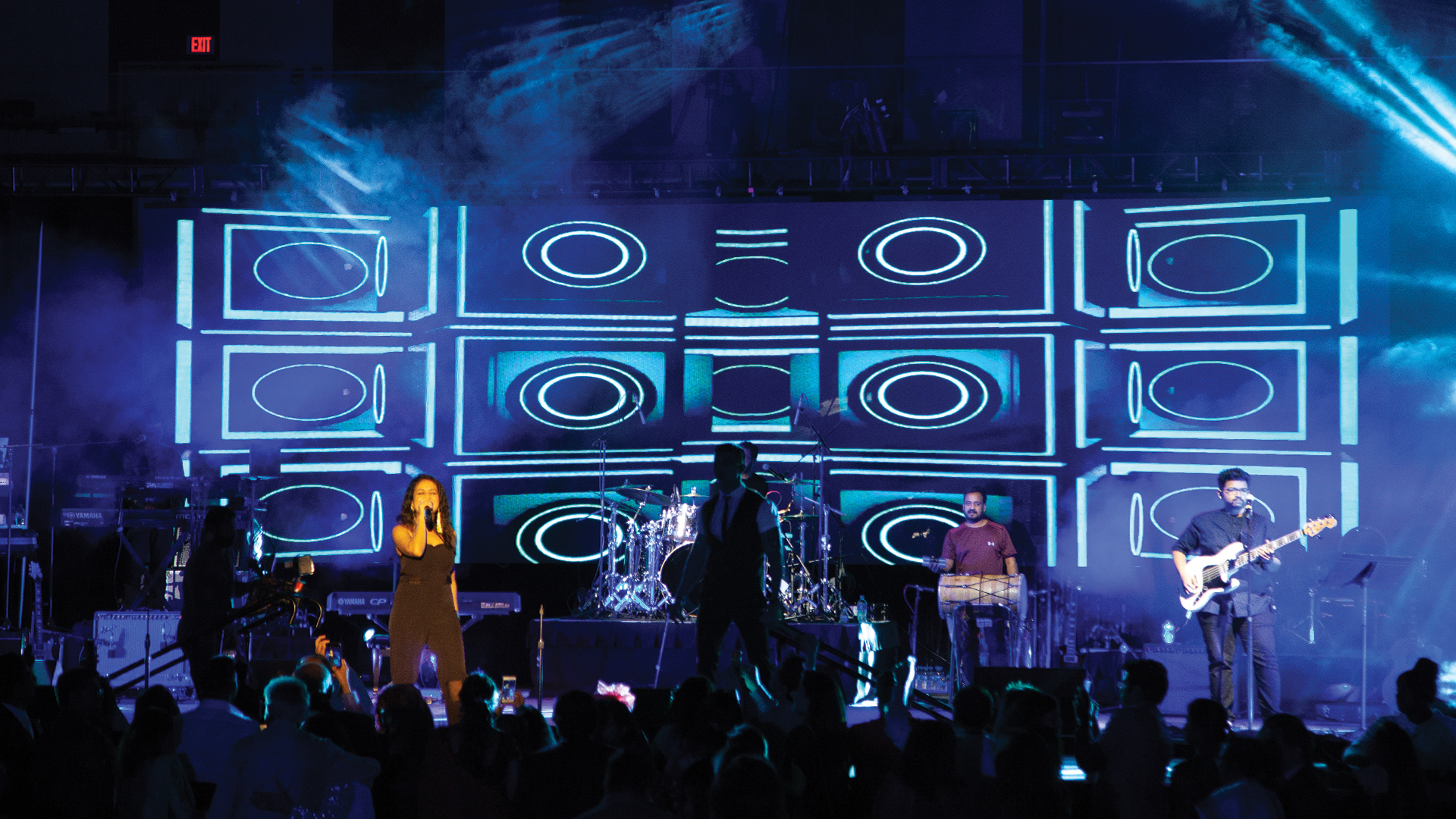
For the first three decades of computer-controlled stage lighting, the fundamental paradigm was simple: fixtures pointed at things. Moving heads tracked performers. PAR cans washed the stage. Intelligent spots followed soloists. The fixture was a source of light aimed at a subject. LED pixel mapping has fundamentally shattered that paradigm, transforming every LED device in a rig — from a single battens to a wall of 10,000 tiles — into a surface that is itself the subject, the canvas, the scenery.
The Technical Roots of Pixel Mapping
The concept of controlling individual LED elements within a larger array — pixel-level control — evolved from the architectural lighting world in the mid-1990s. Early systems from Color Kinetics (founded 1997, later acquired by Signify) pioneered networked LED node control using proprietary protocols. The application to entertainment lighting came as LED technology matured and costs fell enough to make large-format arrays practical for touring.
The first widely adopted show file language for pixel mapping in entertainment was ArtNet — a UDP-based protocol developed by Artistic Licence in 1998 that mapped DMX universes over standard Ethernet. ArtNet allowed a single network connection to carry the data for hundreds of DMX universes, making the control of thousands of individually addressable pixels over a single network backbone suddenly viable. sACN (Streaming ACN), standardized by ESTA as ANSI E1.31 in 2006, followed and is now the dominant protocol for large-scale pixel systems.
How Modern Pixel Mapping Works
At its core, pixel mapping is the process of sampling a video source — a static image, an animation, a live camera feed, a real-time render — and translating each pixel of that source to an intensity and color value sent to a corresponding LED element in the physical rig. The mapping software creates a virtual layout that represents the physical geometry of the rig, assigns each fixture or fixture element to a position in that virtual space, and then essentially crops and scales the video source to fit.
Leading pixel mapping engines used in professional production include Resolume Avenue and Resolume Arena, WATCHOUT from Dataton, Green Hippo Hippotizer, disguise (formerly d3), and the pixel mapping engines built into console platforms like grandMA3 and ETC Eos. Each takes a different architectural approach, but the fundamental workflow is consistent: define the geometry, assign the source, output via ArtNet or sACN to the fixtures.
The grandMA3 Native Pixel Mapping Revolution
Perhaps nothing has democratized pixel mapping in live entertainment more than its integration directly into the grandMA3 console platform. Previously, pixel mapping required a dedicated media server patched alongside the lighting console. With grandMA3’s native pixel map engine — introduced in the MA 3.x software generation — an LD can define pixel mappings, apply media content, and control the result entirely within the show file, without a separate server.
This integration means that pixel effects — chases, gradients, video clips, MIDI-triggered animations — are synchronized directly with the cue stack. A Q-fire triggers both the conventional cue and the pixel content simultaneously, with the same timing and phasing. The result is an expressiveness previously only available to productions that could afford dedicated video content operators working alongside the LD.
LED Fixtures That Unlock Pixel Mapping
The fixture market has responded to the pixel mapping revolution with a wave of products specifically designed to serve as pixel mapping canvases. CHAUVET Professional‘s COLORado PXL Bar series, Elation Professional‘s Proteus Excalibur and KL Panel lines, and Astera‘s AX3 LightDrop and Titan Tube offer individually addressable pixel zones within a single fixture, purpose-built for mapping applications.
The Astera Titan Tube, wirelessly controlled via AsteraApp and outputting ArtNet, has become nearly ubiquitous in pixel mapping rigs for its combination of portability, wireless operation, and individual-pixel-addressable LED count. A single tube can become a raining comet, a color pulse, or a chasing pattern that responds to live content — without a single cable.
Content Creation for Pixel Mapped Rigs
The creative workflow for pixel mapping has spawned an entire subspecialty of motion graphics design for live events. Content designers working in Adobe After Effects, Notch, TouchDesigner, and Resolume Alley create video content specifically formatted for the dimensions and resolution of LED rigs. A 40-meter-wide stage with 200 LED bars requires completely different content design than a 1920×1080 projection surface.
The most sophisticated pixel mapping rigs now use generative real-time content — content that is not pre-rendered but computed in real time based on audio input, MIDI triggers, performer tracking data, or algorithmic animation. Notch and TouchDesigner have become the dominant platforms for this approach, enabling lighting and video designers to create content that genuinely responds to the live performance moment.
What This Means for Lighting Design
The implications for stage lighting design are profound. The boundary between lighting design and video design has dissolved almost entirely in cutting-edge production. The LD is now routinely expected to specify pixel mapping architecture, collaborate on content creation, and operate pixel mapping engines alongside conventional cue stacks. Lighting programmers who have not developed fluency in pixel mapping workflows are increasingly limited in the productions they can work on, as the technique has become standard on everything from touring concert productions to corporate spectaculars.
