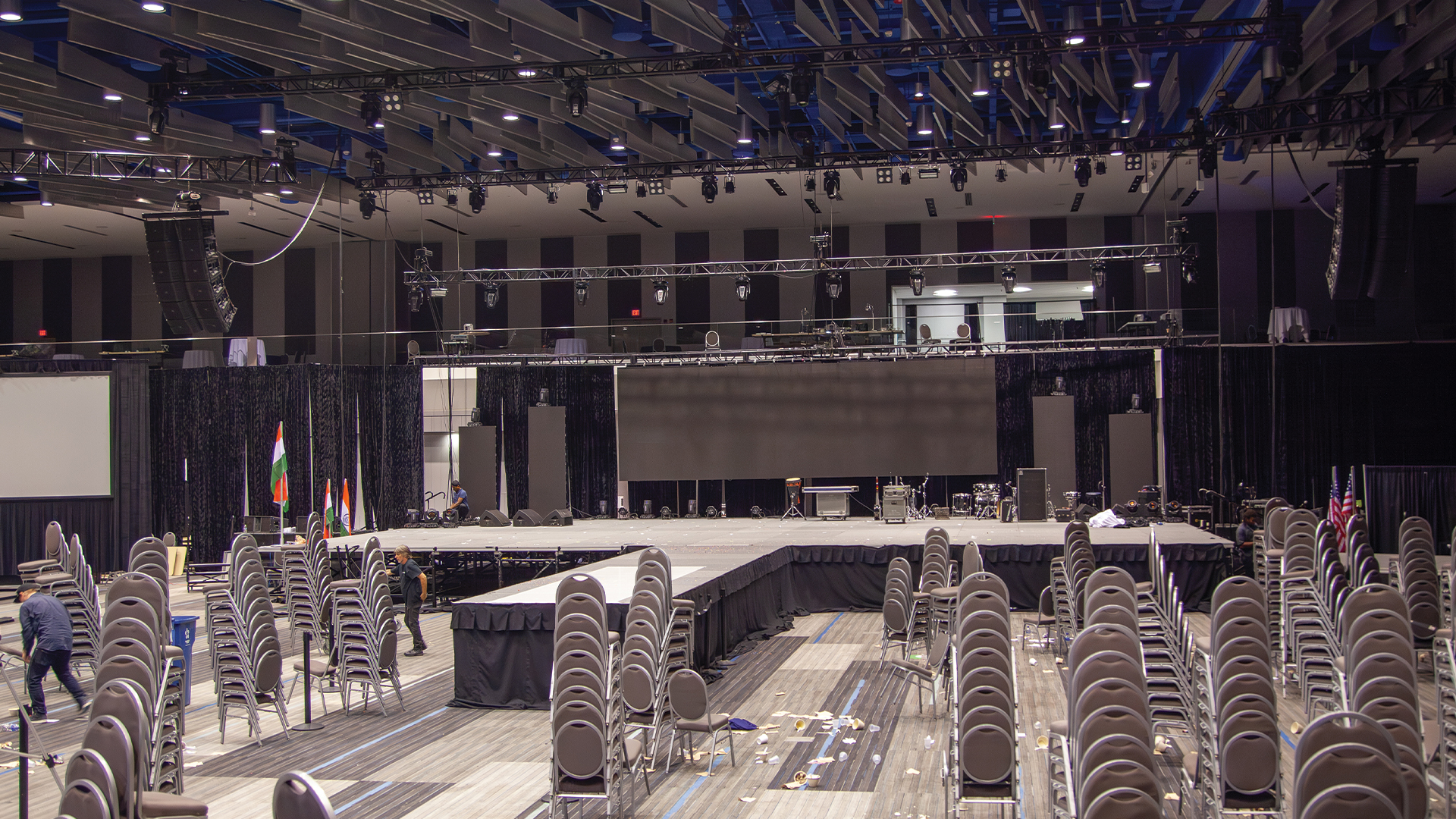
An LED video wall hanging over an audience seating area is one of the most visually spectacular and technically consequential decisions in stage design. When it works — when a massive pixel canvas hangs silently and precisely over the crowd, delivering content at angles impossible from a conventional stage-mounted position — it is transformative. When it fails to meet the engineering, permitting, or safety standards required for overhead rigging over occupied areas, the consequences are severe: from venue denial to catastrophic structural failure. Understanding the complete challenge landscape is essential for any production considering this approach.
The Regulatory Environment for Overhead Rigging
The regulatory framework for rigging over occupied seating areas is significantly more stringent than rigging over stage areas. Most jurisdictions classify areas where audiences sit as public assembly spaces requiring compliance with IBC (International Building Code) provisions for suspended loads, local fire marshal approval, and often a licensed structural engineer’s stamped rigging plan. This is not optional documentation — it is the difference between a rig that gets approved and one that gets red-tagged on load-in day.
The ETCP (Entertainment Technician Certification Program) Rigger certification, introduced in 2003, established a professional credential that many venues now require for all rigging operations. Rigging over occupied areas specifically often requires a second rigging engineer signature on the load calculations — a check-and-verify process borrowed from aerospace and civil engineering disciplines where the consequences of calculation error are lethal.
Load Calculations for LED Wall Rigging
A large-format LED wall intended for overhead installation carries multiple load types that must be independently calculated. Dead load — the static weight of the panels, frames, and structural steel — is the baseline. For a 20×10 meter LED wall using ROE Visual CB5 tiles, for example, total dead load can exceed 3,500 kg. Dynamic load — the forces introduced by motion during installation and removal, and by wind for outdoor installations — must be added as a multiplier, typically 1.5x–2.5x dead load depending on the installation method.
The rigging point capacity of the venue structure — the allowable WLL (Working Load Limit) at each rig point — is the ultimate constraint. Many mid-sized arena and convention center venues have ceiling rig points rated at 1,000–2,500 kg each. A wall requiring distributed loading across eight rig points at 4,000+ kg total is pushing against or beyond the limits of these venues and may require direct structural engineering analysis of the building frame rather than relying on the venue’s standard rig point ratings.
Choosing the Right Motor and Rigging Hardware
Motors for overhead LED wall rigging are selected for precision, capacity, and certification status. CM Lodestar D8+ motors in hoist control configurations, R&M Chain hoists with variable frequency drive control, and Movecat DSH series intelligent hoists are all used for LED wall rigging applications. The critical requirement is load monitoring — each hoist in an overhead array should be equipped with an integrated load cell providing real-time weight data to a hoist controller that can stop the system if loads exceed safety parameters during the lift.
All rigging hardware — shackles, swivels, climbing rope, wire rope slings — must be rated, marked with their WLL, currently inspected, and matched to the load calculation. Grade 80 alloy chain is the minimum standard for entertainment rigging; Grade 100 is increasingly preferred for overhead applications over occupied areas. Hardware without visible rating marks should be rejected and not used.
Secondary Safeties and Contingency Engineering
Overhead rigging over occupied seating requires secondary safety systems — independent backup supports that can catch the load in the event of primary rigging failure. For large LED walls, these typically take the form of secondary wire rope or chain runs attached to independent rig points, rated for the full dead load of the wall without dependence on the primary rigging. ANSI E1.6-1, the entertainment industry’s electric chain hoist standard, requires that hoist systems over occupied areas include such secondaries.
Some productions use structural steel bridles integrated into the LED wall frame itself, distributing the load across more rig points than the minimum configuration would use. Over-engineering the rig point count — using ten points where eight would technically be sufficient — reduces the load per point and creates a system that is more tolerant of a single point failure or an undetected building structure weakness.
Cable Management and Electrical Safety
An LED wall overhead is not just a mechanical rigging challenge — it is an electrical infrastructure challenge. Data cables, power cables, and grounding conductors must be routed from the hanging wall to the production infrastructure below in a way that does not put tension on electrical connections, does not create trip hazards or obstruction during audience movement, and does not present an electrical hazard in the event of a water intrusion incident (outdoor events) or fire suppression discharge.
Best practice is to use cable looms — pre-made bundles of the complete data and power harness for the wall — that are routed through cable trays or J-hooks attached to the rigging structure, with service loops of sufficient length to accommodate the wall’s trim height adjustment range. Strain relief at every connection point is mandatory; unsupported cable weight pulling on a connector above a crowd is both an electrical and a dropping hazard.
Communication and Operational Protocols During Events
Once an overhead LED wall over occupied seating is flying, operational protocols must remain in force for the duration of the event. This includes: no unauthorized access to the rigging area, a designated rigging supervisor monitoring the hoist system throughout the show, pre-defined load thresholds that trigger automatic show stop if the monitoring system detects anomalous loading, and emergency lowering procedures pre-briefed to all department heads. The wall should never be moved — trimmed up or down — while the seating area below is occupied, without explicit clearance from the rigging supervisor and a safety spotter in the affected zone.
